
Sub Floor Ventilation
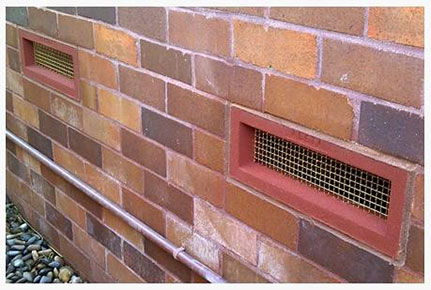
Clause 2.3.8.3. of the Australian Standards A.S. 3600, specifies that the minimum requirement for sub-floor ventilation should be one (1) ventilator of 8,400 mm. squared nett ventilation per lineal metre on both external and internal walls
Vent Type l Vent Size l Area Per Square mm. Terracotta 230mm x 150mm 6,200vent-in-situ
Aleta 230mm x 150mm 11,200 – Galvanised Metal 230mm x 150mm 11,700
Stainless Steel 230mm x 150mm 19,000 – Aleta 380mm x 190mm 28,500
Temp Vent 380mm x 190mm 52,000 – Aleta 450mm x 150mm 29,600
Stainless Steel 450mm x 150mm 55.600
In respect of termite prevention, the new Australian Standard A.S. 3660 calls for the upgrading of ventilation systems to enable the success of non-chemical control methods.
The New South Wales Local Government Ordinance 70, nominates the amount of 2,100mm. squared of air space per metre run of external wall and 4,200mm. squared for internal walls but does give the local council power to reduce or increase this amount where the nature of the site, the design of the building or the provision of waterproof ground cover is considered to justify such a change.
The different opinions as to adequacy are reflected in the differing requirements of other authorities. As some are expressed in square millimetres per square metre of floor area, rather than length of external wall, the figures below are calculated for the arbitrary example of building 20 metres x 7 metres.
New South Wales requires 113,400 square mm.
Victoria requires 395,800 square mm.
New Zealand requires 700,000 square mm.
Australian Standards recommendation
For particle board flooring 405,000 square mm.
It would appear the N.S.W. requirements are such that they should be exceeded rather than reduced, except in special cases, as when a soil cover is used.
CHECK LIST
INSPECTION FOR VENTILATION
1. Ask questions of the client to help in identifying the problem
2. Find out history of damp or pre-condition with the building.
3. Inspect the building Access sub-floor to ascertain const., type.
* Look at and moisture meter test timbers.
* Identify types of fungi present.
* Check for timber pests.
* Identify any mould or mildew internally.
* Check roofing for leaks.
4. Look at the appearance of dampness types and locate cause, extent of any decay, advise on timber replacement and make recommendations within your scope
of expertise.
5. Always sketch the property showing the following:
* Location of existing ventilation.
* Construction type, roof, flooring.
* Mark in new ventilation, coding each item.
* Show different openings into dwarf walls.
* Highlight any obstruction or embankment.
* List any special equipment or instructions.
6. Note on your report of any building faults or problems to the client, eg. rusted gutters, ground seepage, roof leaks, unconnected plumbing, formwork timbers where you may feel it will have an effect on the new ventilation proposal.
7. Quotations will vary and the client may want to reduce the work. Remember that any ventilation increase is an improvement but the degree of success is directly related to extent of work carried out. This must be explained with the submission of a quote.