
Dampness
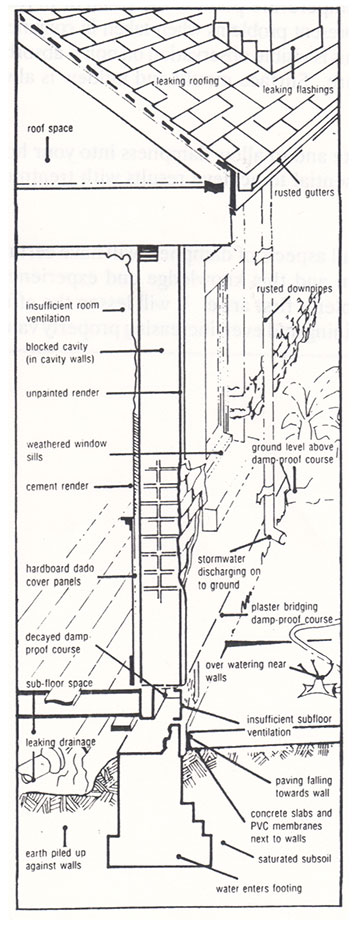
HOW TO IDENTIFY IT
HOW TO RECTIFY IT
Dampness is the sustaining of moisture in the substrate at a percentage necessary to reproduce all forms of wood destroying fungi, mould, plaster rot and nasty musty odours.
You cannot ignore it and hope it will just go away. The presence of dampness, being a relatively good conductor, decreases the insulating efficiency of the materials used.
Trades people use terms like Rising, Lateral, Horizontal, Falling, Penetrating and others to describe a dampness problem. What all these mean is water or moisture which occurs in or to your property, through the roof, walls, from rain, condensation on walls and windows from poor ventilation or rising up from the ground seepage, and dampness in the building foundations.
Dampness can be separated into four areas of occurrence and the cause will dictate the method of treatment, most effective and yet cost efficient.
RISING DAMP
Is associated with the failure or bridging of the original damp proof course. This physical barrier material is installed during a builders construction and can fail with the assistance of excessive seepage in the ground, requiring drainage improvements and dampcourse reinstatement. The proximity of the dampcourse in respect to ground level clearance, the ground water table and the capacity for a damp affected wall to take up rising moisture, are all factors in the diagnosis of Rising Damp and it’s final treatment.
PENETRATING DAMP
Can occur through roof leaks, ie. tiles cracked, rusted metal sheeting, failed membranes to flat roofs. These causes are measured with consideration for the remaining life of any product or system in place to hold out water. In much the same way, a dampness problem to a vertical wall can be related to its cavities and their bridging by builders material that often allows the transportation of moisture inside. Where solid walls have an outer membrane as weatherproof protection, their durability and period of protective life are factors to be investigated when a damp problem is first discovered.
VENTILATION
With timbered floored homes, the underfloor ventilation is designed to maintain the ?equilibrium moisture content in the flooring timbers. The moisture content is crucial and should always be below 20% and desirably between 10% to 15% in seasoned timbers.
Wood decay cannot be sustained or even commence below 20% moisture content, but if the wood?s moisture rises above 20% constantly, decay will attack and eventually destroy the timber. The decay is also a protein source for white ants (sub-terranean termites) and other decay pests such as slaters and millipedes which are often found inside homes.
CONDENSATION
Is surface moisture and will usually be found at the lowest temperature point in the room or in rooms where ventilation is inadequate. Diagnosing condensation can present problems when taken in conjunction with previously mentioned facets of dampness. The most obvious is visible observation on non-absorbant materials, appearing as small beads or a thin film of moisture. Surface mould and mildew is always associated, creating a health risk.
Your home is probably the greatest investment you will make and to allow dampness into your home can be dangerous and expensive. The right diagnosis is essential to achieve results with treatments at a
reasonable cost, in proportion to the problem.
Companies which carry out building consultancy services in all aspects of dampness will have certainly come across a problem with dampness similar to your own and this knowledge and experience is invaluable. Have the property inspected early or when problems first arise. It will lessen the effects and, in the long term, prove more cost effective while maintaining and even increasing property values.