
Termite Colonies in Trees
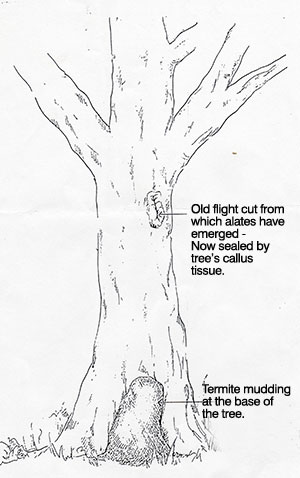
THE DETECTION AND TREATMENT OF TERMITE COLONIES IN TREEStree1
The nest of pest termites, Coptotermes acinaciformis and Coptotermes frenchi are often found in trees and stumps of trees left in the ground. The termite species Schedorhinotermes intermedius is also occasionally found in trees and stumps, particularly when stumps are covered by soil.
In those colonies which make mounds such as Nasutitermes exitiosus, the nest area is more easily located as it is usually in the central area of the mound structure.
Termites are able to attack timber in the ground and buildings by making subterranean galleries from the nest to the food sources. When a nest occurs in a tree or stump outward signs, such as mud like galleries on bark or mud like packing in splits or base of truck, are not always present and it is necessary to drill holes to:
1.Confirm the presence of termites.
2.Locate the central nest area of the colony as an essential pre-requisite to treatment.
1991 – 1992 investigations by a small research group in Sydney has resulted in a probe containing a temperature sensor and digital recorder being modified specifically for the pest control industry.
SELECTION AND PREPARATION OF HOLES
Some trees show evidence of the presence of a colony within while others do not. Unless there is mudding or other signs at the base of rough barked trees, flight cuts are more difficult to identify than those on smooth barked trees.
The following steps and notes on special equipment may assist in the location and treatment of colonies in trees.
1. It is usually not necessary to drill any more than 3-4- holes to locate the nest area for treatment. The temperature sensor is essential to determine the centre of the nest. The first hole may be drilled into the basal area of the trunk and at about 45 degrees and towards the root crown. The second hole may be about one (1) metre from the ground and the third between the other two, but the location depends on this and results of the other two holes.
The following equipment is required for this first step:
a. A 10mm x 400mm auger drill bit. These are minimum dimensions, but it should be remembered that larger diameter drill bits cause more damage to trees. The auger type bit is favoured because it cuts a clean hole thus facilitating the entry of the probe and distribution of the insecticidal dusting chemical.
b. The digital temperature sensor probe is available through the Australian Environmental Pest Management of Australia and has been developed by Mr. Fredrick W Burke, for the pest control industry.
c. A mains electric or battery driven drill depending on the circumstances.
d. A length of flat plastic of a very long blade of grass to insert into the hole for termite soldiers (only Coptotermes spp) will grab. All Coptotermes spp. will leave a white and slightly sticky exudate on it.
e. The insecticidal dust Permethrin traded as Coopex Dust, industrial strength 10g/kg Permethrin 25/75 has bee researched and proven totally effective in the colony treatment of termites in trees.
f. A fungicide is required to avoid secondary damage to the treated tree. Pascals Stop Rot is copper naphthenate and applied using a cotton bud, before filling in of drilled holes.
g. A caulking gun and cartridge of suitable caulking material to seal the holes once they have been used. Fullers Caulk in Colours is a latex acrylic which is available in a variety of colours to match the various coloured barks.
Dowels and putty are not recommended.
2. It may be necessary to re-insert the drill bit to clear the hole (termite workers can partly block these in a few minutes) to receive the temperature probe. As the drill bit and wood create heat during drilling it is best to wait 2-3 minutes before inserting the temperature probe to allow the wood to cool. The effect of this on the temperature readings from within will then be slight.
3. Carefully insert the temperature probe into the area (depth) where the reading is required. The probe may be inserted or withdrawn to locate the highest temperature reading.
4. Once the probe is inserted the temperature reading on the digital recorder will give inside temperature and outside ambient temperature. The inside temperature will rise and fall as the probe is moved towards and away from the nest.
5. The following points will assist in the interpretation of the results:
a) A temperature equal to that outside or just below or just above that temperature indicates the probe is not located in the nest area.
b) A temperature of between 28 and 30 degrees C when outside (ambient) temperature is 22 degrees C indicates the probe is near the nest, but not in it or it is in a very weak or young colony.
c) An inside temperature of between 33 and 36 degrees C indicates the probe is within the nest and to confirm another hole may need to be drilled from another side or from the back of the hole on the opposite side of the tree.
Similar temperatures would confirm the central position of the next.
d) Very hot days should be avoided for colony/nest location as the outside temperature is equal to or almost equal to that in the nest. On such days choose cooler mornings for colony location work.
e) The probe may become covered in a white exudate from the soldiers. This does not mean it is in the centre of the nest or in fact near. It merely indicates the soldiers are attacking a foreign body.
6. Once the nest has been located 250 grams of Coopex dust is blown through the existing drilled holes. After a series of experiments the group has approved the use of carbon dioxide or compressed air at a minimum shotted pressure of 110 p.s.i. (700 kpa). A connected dusting bowl with a modified 10mm x 600mm nozzle tube carries the dust throughout all areas drilled and a uniform dispersal is achieved. The dust obtains a rapid result within hours and, unlike liquid applications, is uniformly dispersed.
INSPECTION AFTER TREATMENT
It is necessary to confirm the effect of the treatment with the digital temperature probe. The time to determine your results can vary and some judgment is required. If the temperature of the colony was determined after one day it is likely to show a significant drop, but if taken again after one week the temperature is likely to be close (if not slightly higher) to that of the original when the nest was healthy.
The increase in temperature is due to the decomposition of the many termite bodies. However, the rise in temperature is likely to over after 3 – 4 weeks from the initial dusting and the entire nest area would be expected to be equal
to or just below the outside (ambient) temperature.
Colonies of Coptotermes spp. Have been successfully controlled using this method of treatment. These termite species develop only one primary queen and the dusting of the colonies nest centre means the death of the colony. Soldiers
and workers away from the colony may be repelled by the chemical, and building activity can continue for a period after treatment, but their fate is sealed without further property damage.
Further research is ongoing to develop specific treatments for other termite species.