
Arsenic Dust
THE USE OF ARSENIC DUST TO CONTROL TERMITES
Arsenic Trioxide, also known as Arsenious Oxide and White Arsenic, is just one of many arsenical compounds used in pest control and other industries.
In pest control arsenicals are used in timber preservation, as herbicides, and for termite control. In other industries it is used in glass making, hide preservation, as food additives in animal food, and in laboratory chemical analysis.
THE MATERIAL (AS2O3)
Arsenic Trioxide is a heavy white powder which is odourless and tasteless, and only slightly soluble in water. It is highly toxic orally (Schedule 7) to mammals and insects but does not easily penetrate intact skin or insect cuticle.
The main risks to users are either from entry via skin wounds or by breathing floating dust. Some users may develop dermatitis if there is frequent skin contamination.
Normal precautions taken for pest control spraying or dusting are adequate protection against the risk of health problems when using Arsenic Trioxide for termite control.
Arsenic Trioxide is much more toxic when used as a finely ground material rather than the coarser commercial grade. In the past it was widely used as a rodent poison, literature on this use found that the finely ground material was
far more toxic to rats than the coarse commercial grade. For termite control it is often diluted down to 10 50% with Ferroc Oxide which also acts as a warning colour.
APPLICATION EQUIPMENT
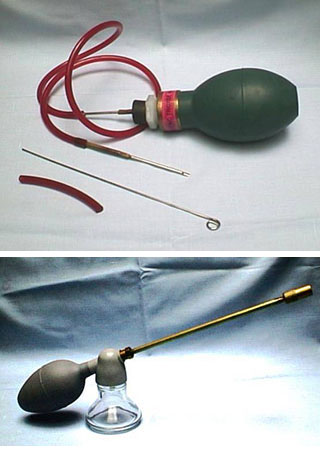
There are two basic types of hand operated applicators or dust blowers.
De-Vilbiss-pufferDe Vilbiss Type
With this type the dust bowl container is separate from the blower bulb, an injector tube connects the two parts. Properly used, this type of applicator gives the correct dust to air dilution necessary for successful treatment of termite galleries. This type of blower will not work with the coarse commercial grade.
Arsenic-Dust—Bulb-pufferBulb Type
This consists of a simple puffer bulb and an injector tube. The arsenic dust is stored in the bulb and some skill is required to obtain the right dust to air dilution necessary for termite control.
APPLICATION TECHNIQUE
With this technique only a minute amount of arsenic dust is used, but properly placed it can kill a remote and hidden termite colony with a population of millions.
The success of this method is due to the fact that the arsenic dust only kills after being eaten. Dust particles in the galleries adhere to the cuticle of passing termites. As there is no reaction to the surface contact the affected termites remain unaware of the potential danger they are carrying. In the colony the termites groom each other and arsenic is ingested, killing the grooming termite. If enough termites pass through the dusted galleries the resulting chain reaction, which includes some cannibalism, will cause the death of the whole colony.
For this type of treatment to have a reasonable chance of success it is essential to follow the recommendations listed below:
1. Always apply this method before a soil barrier treatment is carried out. If required, the soil barrier should be applied only after the dust treatment has been given a minimum of two or three weeks to be fully effective.
2. For the maximum chance of success there should be at least ten widely separated points of treatment.
3. The galleries selected for treatment must contain active termites. When inspection a building where an arsenic dust treatment is to be carried out it is important not to disturb termite activity more than is necessary to identify termite species. Active termites inside accessible timber can be confirmed with a moisture meter rather than opening up the galleries.
4. Only apply a light dusting through the smallest possible opening into the active galleries. Cover the opening with sticky tape or other suitable material. Warning labels can be used for this purpose.If there are plenty of active galleries select one or more of them as check points which remain untreated.
Where you have a choice, it is normal practice to treat activity inside timber and leave main ground to floor galleries as check points.
5. When carrying out check inspections it has been found that two weeks is the minimum interval in summer and three weeks in winter. During check inspections be prepared to retreat if the termites are still active.
6. Where no follow up soil barrier treatment is carried out it is recommended that a further check inspection be carried out after three months.
RANGE OF EFFECT
This technique will only work on subterranean termite species that will tolerate the small amount of disturbance necessary to introduce the arsenic dust into their active galleries.
Experience in New South Wales has shown that this method is effective against Coptotermes species, in particular C acinaciformis and C frenchi. Recent work also indicates that this type of treatment can be effective against
Nasutitermes species.
However, it is rarely if ever effective against Schedorhinotermes species unless in or very close to the colony itself.
In more tropical areas where Mastotermes darwiniensis, Heterotermes and Microcerotermes species can be a problem in buildings, there is not sufficient information to be certain of the effectiveness of this method. However, it is
likely that the skilled application of the arsenic dust technique would be effective against these termite species.
Where there is termite infestation in a building and active galleries are accessible, the arsenic dust method of treatment should always be considered as the initial form of treatment. This particularly applies to situations where
the colony cannot be found and soil barrier treatments are very difficult to put in place.
Australian Standard 3660-1993, listed the arsenic dust method as the only recommendation for remote control of termites inside buildings. Australian Standard AS 3660.2, notes the use of arsenic dust along with other insecticidal dust, toxicant termite baits and application of other effective agents, tested in accordance with AS 3660.3 may be applied.
REFERENCES
Daintith, J. (1981) DICTIONARY OF CHEMISTRY.
Hadlington, P., and Gerozisis, J. (1988) URBAN PEST CONTROL IN AUSTRALIA.
Mallis, A. (1964) HANDBOOK OF PEST CONTROL
National Health and Medical Council (1993) STANDARD FOR THE UNIFORM SCHEDULING OF DRUGS AND POISONS No. 7.
REFERENCES Continued
National Occupational Health and Safety Commission (1989)
ARSENIC AND ITS COMPOUNDS
Australian Standard AS 3660-1993. PROTECTION OF BUILDINGS FROM SUBTERRANEAN TERMITES PREVENTION, DETECTION AND TREATMENT OF INFESTATION.
Australian Standard AS 3660.2 -2000 Termite management, Part 2: IN AND AROUND EXISTING BUILDINGS AND STRUCTURES- GUIDELINES.
Australian Standard AS 3660.3 -2000 Termite management, Part 3: ASSESMENT CRITERIA FOR TERMITE MANAGEMENT SYSTEMS.